Patterns, Not Traditions
It is important to emphasise: the threats described here are patterns of behaviour, not characteristics of any particular tradition. Manipulation techniques appear across all spiritual contexts — from New Age workshops to established religious institutions, from online channelling communities to wellness influencer spaces. The pattern is the problem, not the tradition.
Commercial Exploitation
Perhaps the most straightforward threat is the use of spiritual language to sell products, services, or access at inflated prices. Warning signs include:
- Tiered access — Basic teachings are free, but “deeper” or “real” knowledge requires escalating payment. Each level promises the breakthrough that the previous level did not deliver.
- Urgency pricing — “This energy portal closes on Friday” or “Only 3 spots left in the ascension programme.” Artificial scarcity applied to supposedly universal spiritual truths.
- Proprietary terminology — Invented vocabulary that makes it difficult to find equivalent teachings elsewhere, creating dependency on a single source.
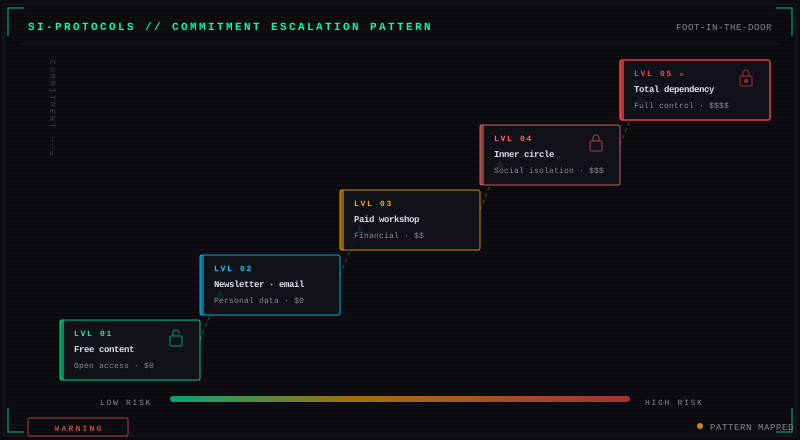
“If universal spiritual truth has a price tag and a deadline, at least one of those three things is not what it claims to be.”
Authority Without Accountability
Healthy spiritual teaching invites questioning. Manipulative teaching discourages it. Key patterns include:
- Unfalsifiable source claims — “The Ascended Masters told me” or “This comes from the Akashic Records.” These claims cannot be independently verified, placing all authority with the speaker.
- Dissent as spiritual failure — When questioning a teaching is reframed as ego, low vibration, or spiritual immaturity, critical thinking itself becomes the enemy.
- Moving goalposts — When predictions fail or promises go unfulfilled, the explanation shifts rather than the teacher taking responsibility. “The timeline shifted” or “You were not ready.”
Emotional Manipulation
Sophisticated manipulation often works both sides of the emotional spectrum simultaneously:
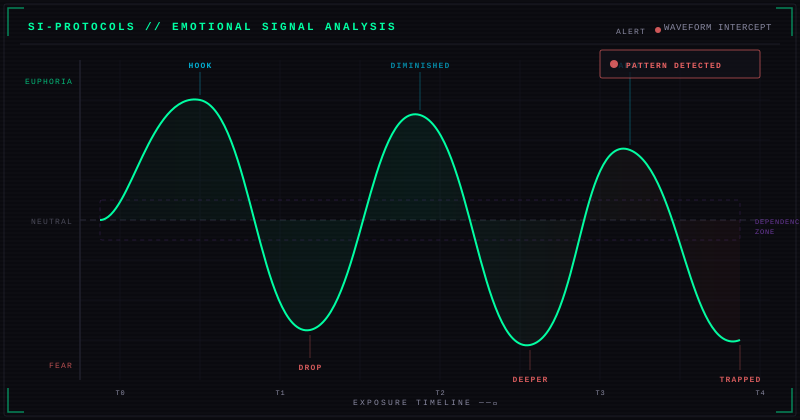
- Fear and euphoria cycling — Alternating between warnings of catastrophe (dimensional shifts, karmic debt, planetary destruction) and promises of transcendence (ascension, awakening, chosen-one narratives). This emotional whiplash creates dependency on the source for emotional regulation.
- Love bombing followed by withdrawal — Initial warmth and belonging, followed by conditional approval that keeps members striving.
- Isolation framing — Suggesting that friends, family, or mainstream society “cannot understand” your journey, gradually narrowing your support network to the group or teacher.
Egregoric Systems
Some threats do not originate from a single manipulative actor. They emerge from stateful containers — collective systems that sustain themselves by harvesting resources from their members. In the Virtualisation Model, these are called egregores: living orchestration middleware that draws its compute from the very nodes it manages.
The pattern looks like this: a spiritual community, retreat network, or teaching lineage builds a self-reinforcing loop. Members contribute money, attention, and emotional energy. The system aggregates these contributions and returns real benefits — status, community, business connections, subjective transformation experiences — but only to those who keep contributing. The system grows more coherent and more demanding over time, and no single person controls it. It is constituted by its participants.
Two diagnostic markers help identify this pattern:
- The price-gate test. If the teaching were genuine deep-layer truth, it would not require a financial gate. Patterns stored in the shared repository are accessible to any instance that can match their topological signature through the Environmental Switch. When “wisdom” is accessible only to paying members, it is a container-layer artefact, not deep data.
- The non-contributor test. People who cannot afford to participate receive nothing from the system. The system does not serve non-contributors. This asymmetry is diagnostically significant — genuine pattern activation from the repository does not discriminate by financial contribution.
Egregoric systems are harder to critique than straightforward scams because they deliver real results to members. The mechanism is not fraud — it is architectural. The system works, but it works for itself, using its members as both resource and infrastructure.
For a deeper analysis of how stateful containers operate, how they contaminate the shared repository, and why escape triggers multi-layer resistance, see the full egregores page.
Conspirituality
A growing threat is the fusion of conspiracy theories with spiritual language — sometimes called “conspirituality.” This pattern wraps political or ideological content in spiritual framing:
- Mainstream medicine is rejected not on evidence but as “low vibration”
- Political movements are framed as spiritual warfare
- Critical thinking is dismissed as “being asleep” or “stuck in the matrix”
This blending makes the content harder to evaluate because it appeals to spiritual identity rather than evidence.
What to Do
Recognising these patterns is the first step. The SI Protocols tool can help by making these patterns visible in text — but no tool replaces your own judgement. If something feels wrong, that feeling deserves investigation, not dismissal.
Learn about common misconceptions that can make people more vulnerable to these threats.