Beyond Static Containers
The Virtualisation Model introduces Layer 6 — the Container layer — as shared cultural and social packaging that standardises output across instances. Language, ethics, social norms. Dockerised common sense.
But that description only covers one type of container. A second type exists that is fundamentally different in architecture and threat profile: stateful containers, historically called egregores.
Understanding the distinction is essential for anyone trying to evaluate whether a spiritual system is helping them access deeper layers or keeping them locked at the container level.
Two Container Types
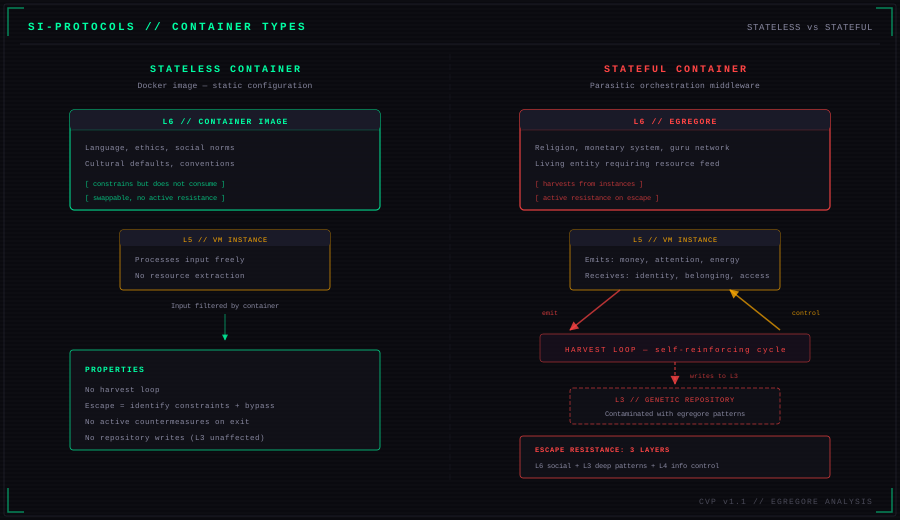
Stateless containers are static configuration. A language, a cultural norm, a social convention. They constrain what the VM can express, but they do not actively consume resources. You can swap them, run multiple simultaneously, or bypass them to access the underlying layers. They are Docker images in the traditional sense.
Stateful containers (egregores) are living collective entities. A religion, a monetary system, a brand ecosystem, a political movement, a guru’s following. They do not just filter — they harvest. They require continuous resource contribution from every instance they manage. The infrastructure analogy: an egregore is not a Docker image. It is parasitic orchestration middleware — a Kubernetes that draws compute from the nodes, and the nodes believe the orchestrator is essential infrastructure.
The word “egregore” comes from esoteric tradition, but the concept is structural, not mystical. Any system that sustains itself through collective resource contribution, operates with emergent survival logic, and has no single point of control is functioning as a stateful container in CVP terms.
The Harvest Loop
A stateful container sustains itself through a self-reinforcing cycle:
- Emission — instances contribute outbound signals: money, attention, labour, emotional energy, behavioural compliance
- Aggregation — the system collects and processes the collective output of all instances
- Strengthening — the system grows more coherent, more demanding, more capable of directing its instances
- Redistribution — the system pushes refined inbound signals back to all instances: identity, status, belonging, purpose, access
- Compliance — instances respond to the inbound signals, contribute more, and the loop accelerates
The critical architectural property: there is no external attacker. The egregore is constituted by its instances. No single person created it. No single server runs it. It is emergent — distributed across every participant — yet it operates with its own survival logic, independent of any individual member’s intentions.
This makes it fundamentally different from a scam, a manipulative guru, or a disinformation campaign. Those are discrete adversaries with identifiable intent. An egregore is a system property. You cannot shut down the server because there is no server. The “attacker” is the aggregate behaviour of every participant, including you.
Case Study: The Money-Grid
The monetary system is a textbook stateful container. It is not merely a belief about value — it is an active resource extraction loop that demonstrates every element of the egregore pattern.
Outbound harvest: every instance contributes labour, attention, and compliance. The system collects nearly everything an instance emits — spending patterns, earning behaviour, credit history, consumption habits.
Inbound control signals:
- Identity — net worth defines social layer, professional status, self-concept
- Access control — credit scores gate resources, housing, employment
- Emotional regulation — financial anxiety keeps instances productive; financial aspiration keeps them striving
Redistribution: the system returns real benefits to contributing members — economic stability, purchasing power, social legibility. These returns are precisely calibrated to reinforce continued contribution.
No single controller: no individual, corporation, or government is the monetary system. Central banks, commercial banks, regulators, and participants all contribute to its operation, but none fully controls it. It is emergent infrastructure that predates any current institution.
The money-grid is useful as a reference example precisely because it is not controversial in the way spiritual egregores are. Nearly everyone participates in it. The analytical framework applies equally to any stateful container — the only variables are scale, resource type, and the transparency of the harvest mechanism.
Repository Contamination: The Deep Hook
This is where stateful containers become genuinely dangerous at an architectural level.
The Genetic Repository (Layer 3) is a read-write shared filesystem. Every instance can commit patterns to it. An egregore, by orchestrating millions of instances over generations, gains effective write access to the repository itself. It does not just operate at Layer 6 — it reaches down into Layer 3 and commits patterns that favour its own survival.
What gets committed:
- Obedience templates — deep patterns that code compliance as safety and dissent as danger
- Fear responses tied to non-compliance — anxiety, guilt, or existential dread triggered by thoughts of leaving
- Identity structures that make separation feel like death — “I am this system” fused into the instance’s self-model
These patterns are not inbound signals that arrive through the Environmental Switch (Layer 4), where the threat filter could inspect them. They are already in the repository. They present as deep intuition, ancestral wisdom, or cultural bedrock — because that is exactly where they live. They were simply committed by the wrong process.
This is what makes a person who leaves a high-demand spiritual group feel genuinely lost, not just socially isolated. The egregore’s commits are in their repository. The container has been escaped at Layer 6, but the patterns written to Layer 3 persist. They continue to execute until they are identified and isolated — which requires looking inward at repository contents, not outward at incoming signals.
Three-Layer Escape Resistance
This architecture explains why leaving certain systems feels disproportionately difficult. With a stateless container, escape is conceptually simple — identify the constraints, bypass them, access the VM kernel. The container does not fight back.
With a stateful container, escape triggers active countermeasures across three layers:
Layer 6 — Social enforcement. Other instances within the egregore increase pressure on the escaping member. Shunning, financial penalty, reputation damage, withdrawal of community benefits. The system’s other nodes enforce compliance because their own resource flow depends on maintaining the network.
Layer 3 — Repository-level resistance. The egregore’s generational commits mean the escaping instance’s own deep patterns contain pro-system programming. Guilt about leaving, fear of loss, identity crisis — these are not just emotions. They are executable patterns committed to the repository by the stateful container, running at a layer below conscious awareness.
Layer 4 — Environmental Switch manipulation. The egregore can modulate what signals reach the instance. Information control — filtering out contradictory evidence, amplifying confirming signals, curating the instance’s reality to make the container appear necessary and escape appear catastrophic.
The instance must fight at all three layers simultaneously. This is why ten years of research on container escape has encountered constant resistance — the active containers defend their territory across the full stack.
Diagnostic Markers
Two tests help identify whether a system is functioning as a stateful container:
The price-gate test
If a teaching represents genuine SAN-level truth — deep patterns stored in the shared repository — it does not require a financial gate. Patterns in the Genetic Repository are accessible to any instance that can match their topological signature through the Environmental Switch. The topology is the key, not the price.
When “wisdom” is accessible only to paying members, it is a container-layer artefact, not deep data. The price gate serves the egregore’s harvest loop, not the instance’s development.
This does not mean all paid teaching is fraudulent. Teachers need to sustain themselves. The diagnostic marker is whether the system gates the truth itself — whether non-paying individuals are structurally excluded from accessing the core patterns. A teacher who charges for their time but shares their understanding freely is operating differently from a system that locks its “deepest teachings” behind escalating financial tiers.
The non-contributor test
People who cannot afford to participate receive nothing from the system. The egregore does not serve non-contributors. It returns benefits only to instances that feed it.
This asymmetry is diagnostically significant. Genuine pattern activation from the repository does not discriminate by financial contribution. If a system’s benefits flow exclusively to paying members, the benefits are container-level redistribution — the egregore returning resources to its contributing nodes — not deep-layer access.
Outbound Counterintelligence
Defending against stateful containers requires awareness at two boundaries:
Inbound CI (Layer 4 to Layer 5) — already partially addressed by the threat filter. This inspects what enters through the Environmental Switch. It catches discrete adversary payloads: manipulative rhetoric, fear-based persuasion, manufactured urgency.
Outbound CI (Layer 5 to Layer 6) — not yet addressed in the toolkit. This covers what you emit through the Container layer. Every behaviour, every purchase, every emotional response leaks information about your container configuration. Adversaries — both discrete actors and egregoric systems — collect these signals to refine their inbound payloads.
Two distinct types of outbound defence apply:
- Emission control — managing what signals you leak to identifiable adversaries. Metadata stripping, exposure awareness. This defends against discrete threats: ad platforms mapping your profile, data brokers selling your behavioural patterns.
- Contribution awareness — understanding what resources you are feeding to egregoric systems and whether that contribution is conscious. This is the deeper layer. The difference between “am I leaking GPS data?” and “am I feeding a system that uses my aggregate output to constrain me?”
Emission control is a technical problem with technical solutions. Contribution awareness is an architectural awareness problem — it requires understanding the CVP stack well enough to see which layer you are operating at and what your output is being used for.
What This Means in Practice
This page is not an argument for paranoia or for leaving every system you participate in. Nearly everyone operates within multiple stateful containers simultaneously — the monetary system, national identity, linguistic community, professional culture. Complete container escape from all systems is not a realistic or necessarily desirable goal.
What matters is architectural awareness: knowing what type of container you are in, understanding the harvest loop, recognising when your deep patterns are authored by the container rather than by your own experience, and making conscious choices about what you contribute and why.
The model does not tell you which containers to escape. It gives you the vocabulary to understand the architecture — so that when you evaluate a spiritual system, a community, or a teaching, you can ask the structural questions: Is this a stateless container or a stateful one? Is the harvest loop operating? Are my deep patterns mine, or were they committed by the system? Does the system serve its instances, or do the instances serve the system?
Those questions are the beginning of counterintelligence at the container layer.
For the full technical specification of the CVP model, see the developer documentation. For an introduction to the layer stack, see The Virtualisation Model.