Beyond the Score
A threat score tells you how much manipulation a text contains. But it does not tell you where the manipulation lives, or how the pieces connect. Topology analysis fills this gap by extracting individual claims from a text and mapping their relationships — giving you a structural view of what is being said and how it holds together.
Think of it as moving from a thermometer reading to an X-ray. The temperature tells you something is wrong; the image shows you exactly what.
What “Mapping Claims” Means
The topology module reads a text and extracts its individual statements — the specific claims being made. Each claim is then classified along four axes:
- Testability — Can this claim be tested or falsified? “Meditation reduces cortisol” is testable. “The Ascended Masters have chosen this moment” is not.
- Source checking — Does the claim reference verifiable sources? Peer-reviewed studies, named experts, and specific historical events score well. Unnamed cosmic authorities and unattributable ancient wisdom do not.
- Domain mixing — Does the claim stay within one knowledge domain, or does it bridge unrelated fields without justification? Linking quantum physics to spiritual awakening without scientific basis is a common manipulation pattern.
- Rhetorical role — Is the claim load-bearing (essential to the argument) or decorative (emotional padding that sounds meaningful but carries no informational weight)?
Three Kinds of Claims
Based on these four axes, each claim is classified into one of three kinds:
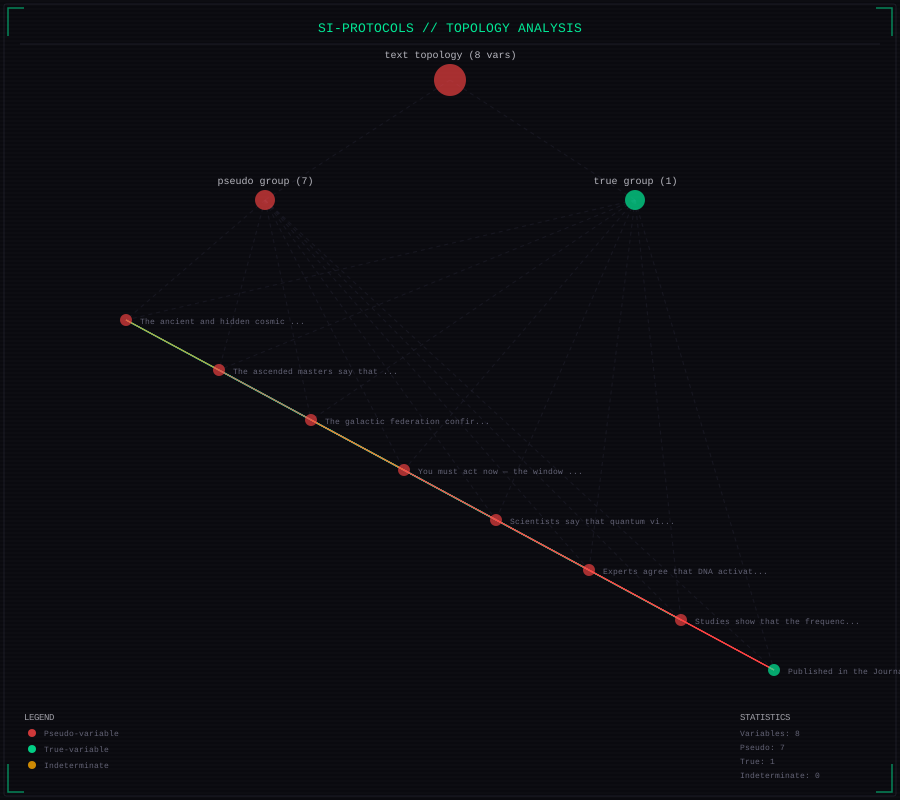
- Pseudo — claims that score high on unfalsifiability, lack verifiable sources, mix domains inappropriately, or serve primarily rhetorical rather than informational purposes. These are the claims most likely to be carrying manipulation.
- True — claims that are testable, well-sourced, domain-coherent, and informationally substantive. Their presence in a text is a positive signal.
- Indeterminate — claims that fall between the two. They may be genuine but poorly sourced, or testable in principle but not yet tested. These deserve further investigation rather than immediate judgement.
The point is not to declare claims right or wrong. It is to make visible which parts of a text rest on solid ground and which float free of any anchor.
The Layered View
The topology analysis presents claims at three levels:
- Individual claims (micro) — each extracted statement with its classification and scores
- Grouped by kind (meso) — summaries of the pseudo, true, and indeterminate clusters
- Whole text (macro) — an overall picture of the text’s structural composition
This layered approach reveals patterns that a single score cannot. A text might contain genuine, well-sourced claims alongside pseudo-scientific assertions — the layered view shows you exactly where the boundary falls.
Why This Complements the Threat Score
The threat score and topology analysis answer different questions:
| Threat score | Topology analysis | |
|---|---|---|
| Question | How manipulative is this text? | What is this text made of? |
| Output | A number (0–100) | A structured map |
| Strength | Quick assessment | Deep understanding |
| Use case | Screening and triage | Investigation and learning |
Used together, they provide both the alert and the explanation. A high threat score tells you to look more closely; the topology map shows you where to look.
A Thinking Tool, Not a Verdict
This analysis is designed to support your own discernment, not to replace it. A claim classified as “pseudo” is not necessarily false — it may simply be difficult to verify by conventional means. Similarly, a claim classified as “true” is not necessarily trustworthy in context — true facts can be arranged to support manipulative narratives.
The topology map is a lens for structured thinking. It helps you ask better questions: Why are the load-bearing claims in this text all unfalsifiable? Why does this argument mix quantum physics with spiritual practice? Where are the verifiable sources?
These are the questions that strengthen your ability to engage with spiritual content on your own terms.
Continue to The Virtualisation Model to explore the conceptual framework behind these classifications — where claims come from, and why some content resonates deeply whilst carrying manufactured conclusions.